Open shelving can be the most characterful feature in a room or its most cluttered eyesore. The difference comes down to intention. A well-styled shelf tells a story about the people who live in the home, displaying beloved books, collected objects and small touches of nature in a way that feels personal but composed. Here is how to get it right.
Start With a Clear Shelf
The most common mistake is trying to style around existing clutter. Remove everything from the shelves first and give them a thorough clean. Then, gather the items you are considering displaying and lay them out on the floor or a table where you can see them all at once. This editing process is crucial. Not everything deserves shelf space, and the items you leave off are just as important as the ones you include.
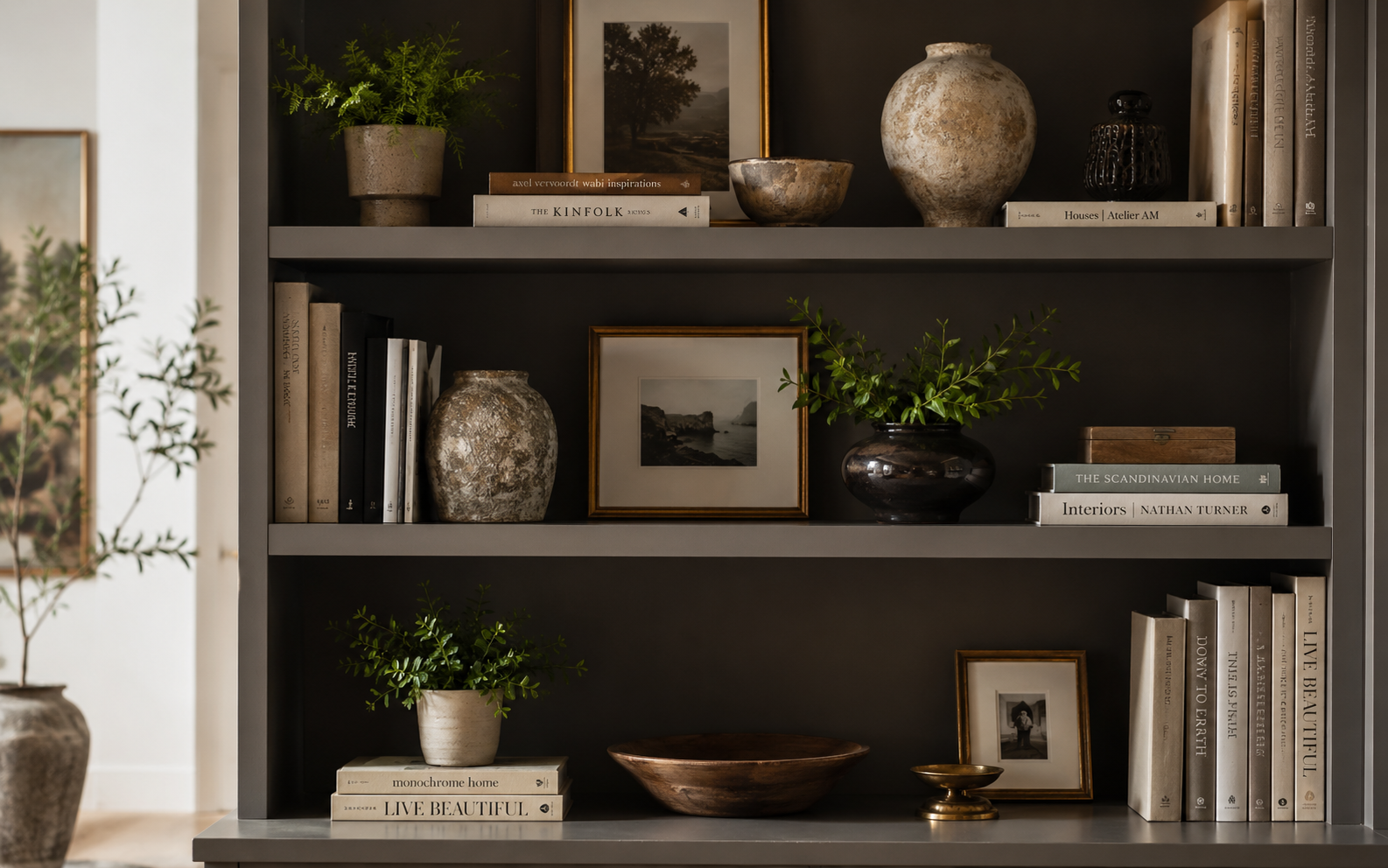
Aim to fill roughly sixty to seventy percent of the available shelf space. Leaving breathing room between objects prevents the display from feeling cramped and gives each piece its own moment. If a shelf looks empty, resist the urge to fill it. That negative space is doing important visual work.
Create Visual Groupings
Objects arranged in groups of three or five tend to feel more balanced than pairs or single items. A small vase, a candle and a stacked pair of books create a vignette that the eye reads as a cohesive unit. Vary the height within each grouping, placing taller items at the back and smaller ones in front, to add depth and prevent a flat, uniform look.
Books are the backbone of most shelf displays. Use them both vertically and horizontally. A horizontal stack of two or three books creates a platform for a small object on top, while vertical rows of books provide structure and rhythm. Sort by colour for a curated look, or leave spines facing outward for a more relaxed, library feel.
Texture, Colour and Nature
The most interesting shelves combine a variety of textures: the smooth glaze of a ceramic bowl, the rough grain of a carved wooden figure, the soft drape of a small textile. This tactile variety keeps the eye moving and prevents the display from feeling monotonous, even when the colour palette is restrained.
Speaking of colour, limit your palette to two or three tones that complement the room. If your living room features warm neutrals, carry those tones onto the shelves with cream ceramics, brown leather-bound books and natural wood objects. A single pop of colour, perhaps a green trailing plant or a blue vase, provides a focal point without overwhelming the arrangement.
Greenery is almost always a good addition. A trailing pothos, a small succulent or even a sprig of dried eucalyptus softens the hard lines of shelving and brings life to the display. Plants introduce an organic, slightly imperfect quality that prevents the arrangement from looking too staged.
Evolve Over Time
The best-styled shelves are not fixed installations. They evolve with the seasons and with your life. Swap in a new book you have just finished reading. Add a souvenir from a recent trip. Replace a wilting plant with a fresh one. This ongoing curation keeps the display feeling current and genuine rather than frozen in time.
Do not overthink it. The goal is not perfection but personality. A shelf that reflects your interests, your travels and your taste will always be more compelling than one copied from a catalogue. Trust your eye, edit ruthlessly, and remember that the simplest arrangements are almost always the most effective.